
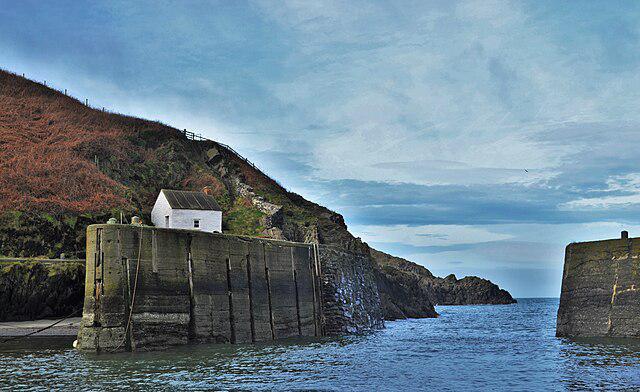
Porthgain is a quiet little harbour hamlet found in the Pembrokeshire Coast National Park.
Sitting between St David’s and Goodwick it is a part of the Parish of Llanrhian. The
onomastic evidence for the place name is debated, some have identified it as having been
derived from the Welsh for ‘fair port’, but it is more likely to originate from the Welsh word
porth meaning port and gaing meaning chisel. This would tie in nicely with the slate working
history of the port which was bustling with industry from the nineteenth century onwards.
The most interesting aspects of this history are the formation of the Porthgain Railway and
the workings of its Quarry but also the recent past and how this little harbour village
continues to attract visitors and sustains itself long after the riches of industry collapsed.
The Porthgain Railway
As one explores the modern village of Porthgain, many reminders of its time as a successful
export harbour are still visible. During the 1800’s, Porthgain shipped slate from several local
quarries including Abereiddi, Trwynllwyd and Porthgain quarry itself. Abereiddi and other
quarries to the south were linked to the harbour by a tramway, the Porthgain Railway. The
Porthgain Railway was a 3ft narrow gauge industrial railway that connected several
Pembrokeshire quarries with the exporters in Porthgain harbour. It operated between 1888
and 1931. For those interested in walking the routes of old railway lines, the tracks of the
Porthgain Railway can still be followed along a levelled strip across the clifftop overlooking
the path down to the harbour. Several locomotives ran the tracks during its time in use. The
Porthgain No. 1185, built by Andrew Barclay in Kilmarnock, Scotland, was supplied as new
to the railway in 1909 and was in use until 1929. It was scrapped on site two years later.
Another loco the Charger No. 1381 had a storied past. Built by W.G. Bagnall in 1891 at his
engine works at Stafford, England the Charger first worked at Palmers Shipbuilding and Iron
Co. Ltd. At Jarrow until 1908. It was then used in the construction of Blackwater Reservoir in
the mountains above Kinlochleven in the Highlands of Scotland. Porthgain Railway acquired
the engine in 1912, and it was in operation on the line until the railway’s closure in 1931.
Another engine, Singapore No. 659 constructed by the Kerr, Stuart and Company Ltd. In
Stoke-on-Trent in 1899 first saw action during the construction of the Burtonport extension
of the Londonderry and Lough Swilly Railway in Ireland. After 1903, Singapore was also sent
to Rannoch Moor to assist with the building of Blackwater Reservoir. Porthgain Railway
acquired the engine in 1912 and ran it until 1929. Finally, Newport No.311 was purchased by
the Porthgain Railway company in 1929, the last of their acquisitions, running until the
closure in 1931. Newport was a Hudswell and Clarke model and had been built in their yard
in Leeds in 1889, originally of the 2ft 10in gauge design it ran on the railway at
Cwmmclydach Collierry, Swansea until 1899. It was then sold for use in the Elan Valley
Reservoirs projects. The Elan Valley Reservoirs are a series of manmade lakes formed by
damming the Elan and Claerwen rivers that run through the Elan Valley in Mid Wales.
Controversially, these reservoirs were constructed by the Birmingham Corporation Water
Department to provide drinking water for Birmingham, some one hundred miles away. After
contributing to this project, Newport was regauged to 3ft in 1908. Between 1908 and 1929
various construction contracts required the locomotive until the engine was eventually sold
to Porthgain. The Newport remained in the engine shed of Porthgain Railway well after its
disuse, only scrapped in 1953.
The Porthgain Quarry
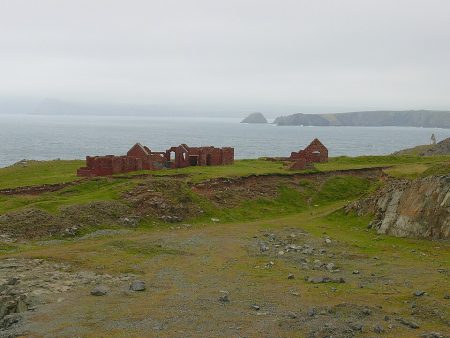
Porthgain quarry is to the north of the Pembrokeshire coast. A small pit which was worked
to produce mainly slab was opened in 1831 and quickly grew into a self-contained
community largely dependent on its capability for maritime communications. The extracted
materials were carried up to the high ground to a water-powered mill near to Porthgain
harbour. As the pit was deepened, steam power was used to operate a cable railway.
Engines of sixteen horsepower and twenty horsepower were recorded in use at Porthgain
during its operations. However, by 1898 Porthgain was one of the declining quarries with
just four workers recorded that year. The twentieth century saw the deterioration of slate
quarrying into shales that were used for brick making and construction. Uphaulage from the
pit was now no longer necessary as a tunnel had been constructed at bottom level that
allowed carts to be filled by use of a chute. Further upgrades took place in the form of brick
hoppers to load granite brought from the quarries by locomotive powered railway. Slate
work at Porthgain Quarry did not continue after 1910 but crushed granite was still being
transported from other locations on the railway until the 1930’s. Although, long out of use
the pit survives along with its tunnel and the incline to the mill which unlike the rest is now
barely visible. Other surviving structures include a fine slate leat, the harbour office (now
being re-used), and the remains of some brick kilns.
Far away in Australia…
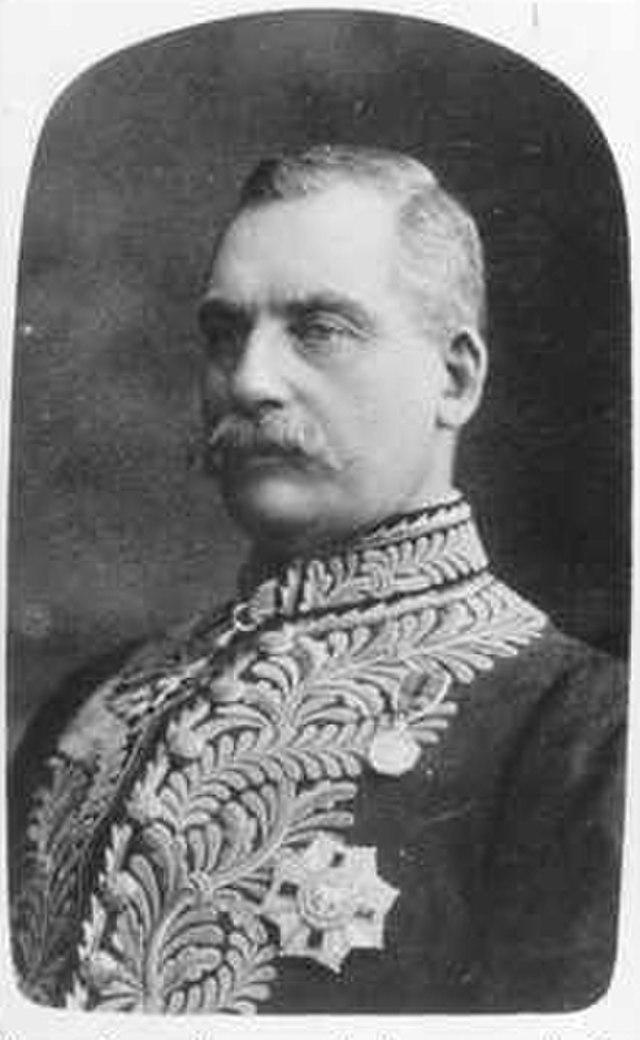
Porthgain’s most famous son was Sir George Ruthven Le Hunte, a British politician and
recipient of the Most Distinguished Order of Saint Michael and Saint George. Sir George was
born in Porthgain on 20 August 1852, to George and Mary Le Hunte. He attended Eton
College and Trinity College, Cambridge before embarking on a career as a British diplomat.
Le Hunte first served as President of Dominica from 1887 to 1894, before taking up the
office of Secretary of Barbados (1894-1897) and Mauritius (1897). His next post was as
Lieutenant-Governor of British New Guinea from 1899-1903 which was then proceeded by
his most esteemed office, that of Governor of South Australia from 1903 to 1909. In his time
as South Australian Governor, Sir George became the first patron of the Royal Automobile
Association of South Australia when it was established in 1903. Furthermore, the District
Council of Le Hunte in the northern reaches of the Eyre Peninsula was named in honour of
him until it was changed to Wudinna District Council in 2008 to reflect the Aboriginal name
prior to British colonialism. After the federation of Australia, Le Hunte served as Governor of
Trinidad and Tobago from 1908 until 1915. He retired from government a year later at the
age of 64.
Survival through the Arts
Although the industriousness of Porthgain has long died out, the village very much still has a
pulse some may say a thriving heartbeat. Prime reason among them – modern Porthgain is
home to the Harbour Lights Gallery, a place which keeps the local culture alive. The gallery is
a family business that is both independent and commercial, selling various forms of Welsh
art and sculpture. Most of the artists on display are Welsh natives who draw their
inspiration from the surrounding Pembrokeshire coast and its wildlife. As well as these local
artists the traditions of earlier Welsh artists, the twentieth century greats, are available in
print to draw together a sense of Welsh artistic history. At any one time the gallery can
display over 40 artists with no permanent exhibitions meaning that the work on display is
always rotated to offer fresh inspiration for visitors every time they walk through the doors.
With a variety of mediums, styles and price points the gallery draws many to the small
harbour village of Porthgain and has made the local community a vibrant hotspot for young
artistic talent. This makes it a truly unique place in Pembrokeshire and one which is helping
keep Porthgain on the map in the 21 st century.
From slate works to slate artworks the history of Porthgain is an interesting one. It tells a
familiar story of a village that reached new heights during the Industrial Revolution but
declined dramatically at the turn of the twentieth century. Since then, it has tried to
reinvent itself to keep the soul of the harbour alive. It could be argued that Porthgain is one
such village that is succeeding in this task for it now attracts many holidaymakers,
recreational fishermen and as noted, artists. Moreover, the Pembrokeshire Coastal Path
runs through the village parallel with the harbour bringing trekkers and cyclists to its doors
to sample some real Welsh culture.
Cover image: Porthgain Harbour by Deborah Tilley: https://creativecommons.org/licenses/by-sa/2.0
Written by C. James McPherson MA MSc.