
One of the earliest records we have of a monastic presence at Binham comes from a text called the Miracles of St. Edmund. In 1091, William Rufus (r.1086-1100) summoned an army to march into Scotland. This was in response to the incursions by the King of Scots into northern England in the preceding months. A knight, of the Abbey of Bury St. Edmunds, which owed the service of forty knights, went on this expedition. On leaving, the knight sent word to his son, who was being educated as a clerk in the monastery’s cell at Binham in Norfolk and suffered from bad eyesight, to head for the abbey to be cured. On 20 November while his father was still on campaign the son was miraculously healed.
Foundation
Following the Norman conquest of England, William the Conqueror and his kin set about on a programme of not only a wholesale redistribution of land but also a massive reorganisation of church and state. As such this period is most remembered for the building of grand cathedrals, parish churches and monastery after monastery. At the centre of this boom was the Benedictine Order. Their monasteries were the superior centres of spirituality and learning.
Binham Priory was no different, as we see in the opening passage that the knight’s son had been sent to the Benedictines at Binham to receive an education. Although, it is hard to say what Binham would have looked like for the young man as the first stones were laid the same year, 1091. Perhaps there were simple timber structures on the site to house the first monks while the great building was erected.
Indeed, Binham was planted in the first wave of monastic foundations and may well be Norfolk’s first monastery to be established by Norman nobility. Peter des Valoines, the nephew of William the Conqueror, had been granted the manor of Binham and established the priory around the same time foundations were being laid for the Cathedral Priory for Benedictine monks in Norwich.
The Priory and its Surviving Features
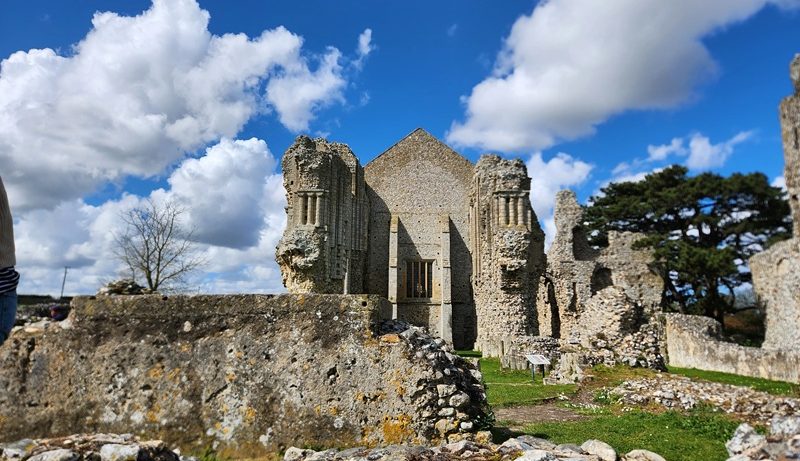
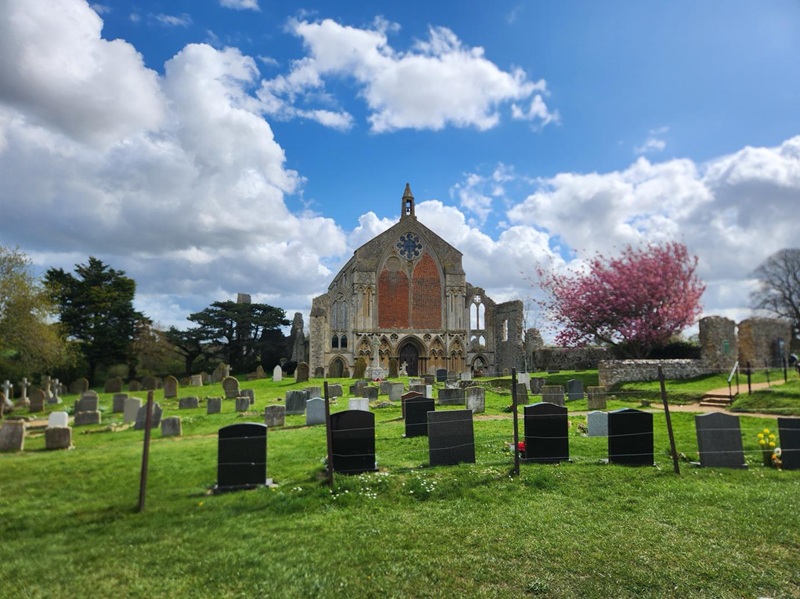
What can be seen today is the remains of the nave of the priory church which was originally a cruciform building with central crossing tower. The nave survives due to its conversion to the local church after the Reformation.
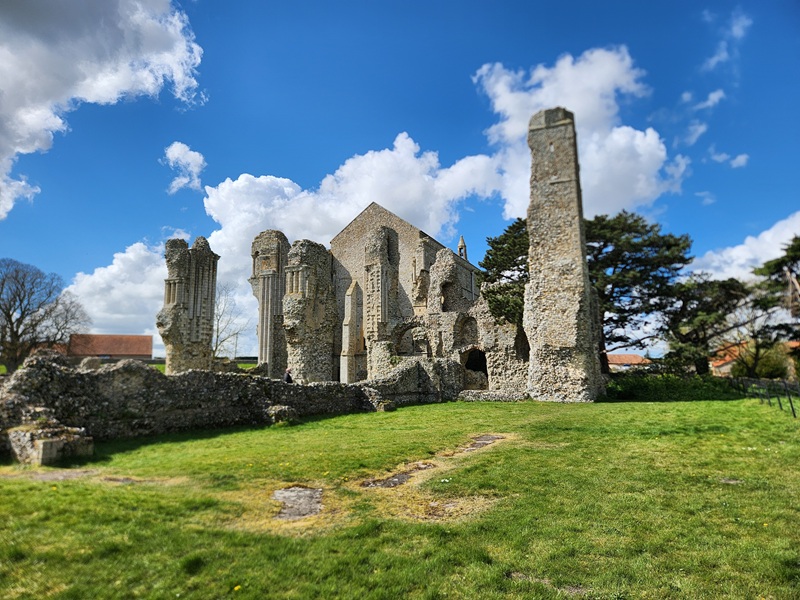
Building too some 150 years from start to finish with foundations stones laid in 1091, construction well underway by 1100 and completed by 1240. Such a span of time makes Binham Priory a fascinating visual historical record of changing styles and capabilities blending Norman and Gothic stone masonry into a beautiful patchwork priory. To some it may appear disjointed but to the historian an eyewatering treasure trove.
One of Binham’s many jewels are the earliest, or at least one of the earliest, examples of bar tracery in Britain. Bar tracery is a method of making shaped pieces of stone with halving joints similar to woodworking. With this method you can design more complicated pieces and additionally have larger windows as the stonework has greater structural strength.
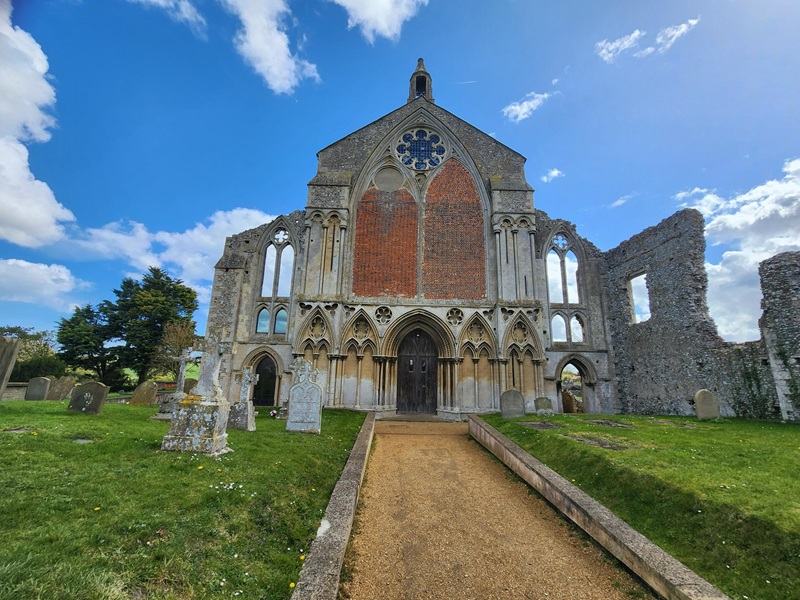
(Early examples of bar tracery)
This benefits of bar tracery are immediately obvious to any visitor who is immediately faced with the silhouette of the enormous west window. Although now sealed shut with Georgian red bricks these windows were once full of beautifully ornate coloured stained glass. Alas, the glass was lost in the 1800s but there are examples of similar stained-glass panels rescued from the monastic buildings on display inside the church.
Another exquisite survivor is Binham Priory’s East Anglian Seven Sacrament Font. This wonderful piece features eight decorative panels, the eighth being chosen by the font’s patrons. The remaining seven depict the holy sacraments of baptism, penance, confirmation, communion, marriage, priesthood and service to the dying. Each tile features skilful imagery aided by the use of Caen limestone rather than the Barnack limestone of the rest of the building. This is because Caen is finer and more easily carved.
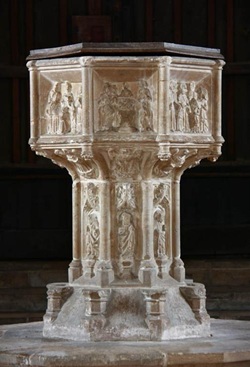
On close examination of the depiction of marriage, we see the joining of the hands by a priest, however the faces are missing. In fact, all the font’s faces have been chiselled off even those of the angels. This would have happened during the Reformation, possibly during the reign of Edward VI who was a staunch Protestant and firmly against Catholic imagery. Such acts of desecration are a real shame for the modern interest as the font would have looked splendorous in its day, not to mention the colours. Peeking out through the cracks in the limestone are flecks of turquoise blue paint. Like most medieval sculpture that we see today the font is now bare stone, but what is easy to overlook is the evidence for the bright colours used to decorate these items. Freshly carved and freshly painted the Seven Sacrament Font would have been the pride of Binham Priory. Today, Binham houses one of only 16 Seven Sacrament Fonts in Norfolk to survive. Unique to East Anglia the only others can be found in Suffolk, where there are a further 12.
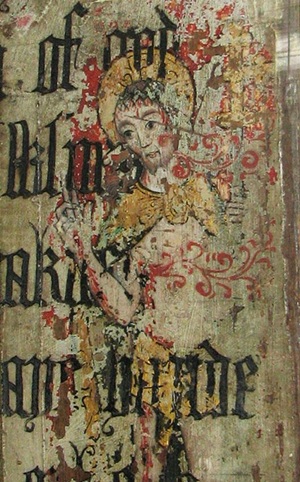
Binham Priory is also home to an original rood screen. The surviving sections are perfectly preserved in a museum standard display also inside the church. A rood screen was the dividing line between the congregation and the sanctuary where the priest would say Mass. During the Reformation this highly decorated screen which depicted various saints and biblical figures was whitewashed and subsequently painted with text from Thomas Cranmer’s Bible in the vernacular English rather than the Latin predominant in the Roman Rite. However, much to a medievalists delight, the centuries that have passed have seen the white paint peel and fade revealing the beautiful artworks beneath. Some of the figures are even crowned in intricate gold-work. This gilding was achieved by hammering gold coins into a very thin almost leaf-like sheet which was then applied to figures right across the screen. Classic pre-Reformation imagery can also be seen at Ranworth, but Binham may be the only example of the juxtaposed religious styles on one screen.
Architecture
The defining features of the nave’s interior architecture are the decorative arches which actually vary in decoration and in shape. These arches demonstrate a shift in the dominant architectural style almost in real time. The round headed arches are classic of the early Norman period from 1100 to 1130 but as you move along this row of arches the final one is markedly different. * This pointed head is what is generally now called Gothic and was developed in Northern Frace shortly after this period and became the quintessential form for churches. Looking up toward the top row these round headed arches are supported by lovely pillars, a fine example of the Romanesque or copycat style of the Normans. However, casting your eyes along the mouldings of the arches and over to the opposite side of the nave you notice they are also unmatched. One can imagine the two different gangs of stonemasons employed on the build who chose to use their own favoured styles.
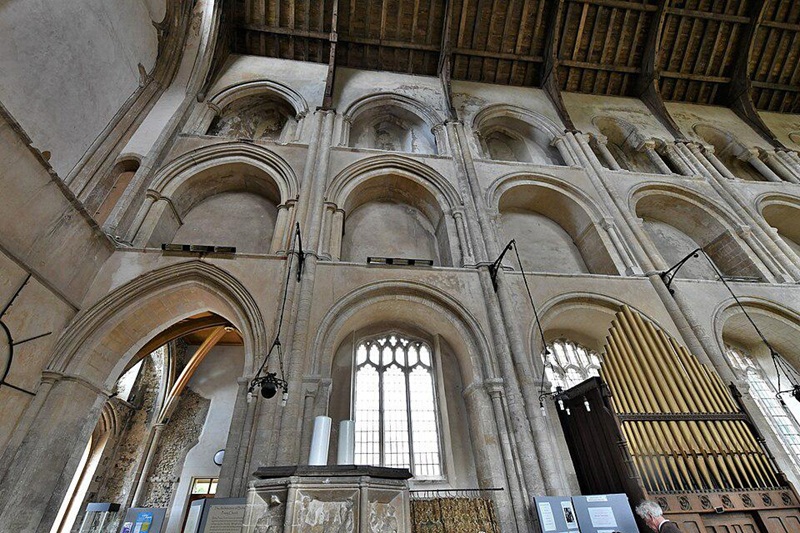
The nave then is a beautiful tapestry of the one hundred and fifty years it took to complete the priory: an 11th century foundation with signs of 12th century innovation and 16th century dissolution. Unlike other churches in England, Binham avoided any meddling in its fabric or artwork by the Victorians. This was in part due to the relative poverty of the parish, but although the 19th century parishioners may have fallen on hard times Binham Priory was able to survive through to the 21st century with its gorgeous history intact.
Who were the Benedictines?
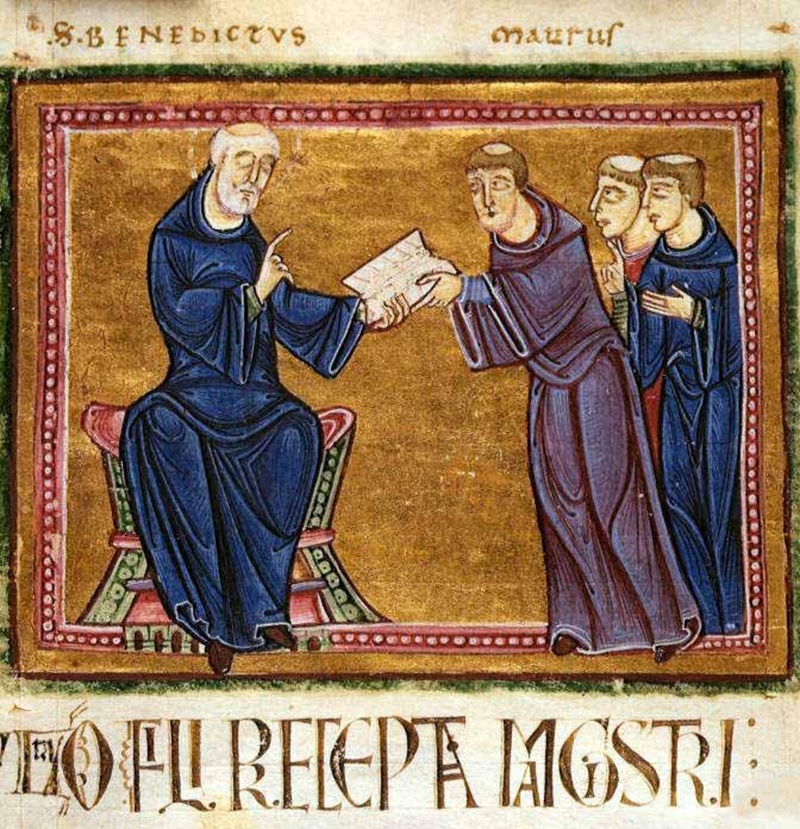
What did daily life at Binham Priory look like in the Middle Ages? Well, the Benedictine Order is an ancient monastic family of monks who live by the Rule of Saint Benedict. Written by St. Benedict of Nursia c.530 AD, the Rule is rooted in the motto Ora et Labora – pray and work. An average day at Binham would have been governed by a strict daily routine centred on the Divine Office outlined in the 73 chapters of the Rule. The day began during the night with Vigils (Matins) at around 2:00 a.m., followed by Lauds at dawn and Prime in the early morning. The remaining offices—Terce (mid-morning), Sext (midday), None (afternoon), Vespers (evening), and Compline (before sleep)—punctuated the day. Between these services, monks divided their time between prayer, study, manuscript copying, and manual labour. Silence, communal meals, and obedience to the Rule of Saint Benedict shaped every aspect of monastic life.
But who were the Benedictines at Binham really?
The monks of Binham Priory and in particular their priors were truly far from faithful adherents to the Rule. Around 1212 the prior, Thomas, sided with a local baron over a land dispute with the Abbot of St Albans (the mother house). As a result, the Abbot forcibly removed Thomas as prior. The baron Robert FitzWalter demanded Thomas’ reinstatement producing a document (probably forged) that only he had the power to install or remove the Prior of Binham. When the Abbot refused, Fitzwalter gathered a small army and laid siege to the priory with the starving monks inside reduced to eating bran and drinking rainwater. The besieged were only saved when a message reached King John who famously erupted with: ‘By God’s feet! Either I or FitzWalter must be King of England!’. The King’s men were dispatched immediately from London and Fitzwalter fled at first sight of the royal standard.
Shortly after this episode, a man by the name of Alexander de Langley – one time prior of Wymondham Abbey – came to Binham. Alexander reportedly went insane from overstudy of the scriptures and would often fly into fits of rage and frenzy. The Abbot of St Albans had him chained, flogged and kept in solitary confinement until his death. So fearful of his malady his fellow monks buried him in his chains.
In 1317, William de Somerton became prior at Binham and quickly set about liquidating the priory’s assets to fund his fascination with alchemy. Such a futile endeavour was only successful in making Binham poorer. Somerton managed to sell off relics, chalices, seven golden rings and many silver cups and spoons. When the news of this behaviour reached the Abbot of St Albans, he announced his intention to visit the priory to put things right. De Somerton outright refused resulting in yet again royal intervention. Edward I ordered the arrest of de Somerton and his monks, of which there were thirteen. Six of the monks found themselves imprisoned but de Somerton had managed to escape to Rome. Despite all this, de Somerton eventually returned to Binham and even manage to work his way back up to prior before running away again after racking up debts equivalent to half a million pounds in today’s money.
If that wasn’t bad enough for Binham, the mid-fifteenth century saw the arrival of William Dyxwell as prior. He was later deposed in 1461 because he “wandered from place to place like a vagabond”. However, his strange dress and vagrant behaviours could not have been so distasteful because he was reinstated just a year later, this time ‘for life’.
With a track record like this one is it any wonder why Henry VIII’s men had no problems dissolving the Priory in 1539.
Written by C. James McPherson MA MSc.
Bibliography
Frank Barlow. William Rufus. Yale University Press, 2000.
Leslie Marr. Binham Priory: a guide to the Priory Church of St Mary and the Holy Cross. Curwen Press, 1966.
Luke Sherlock. Forgotten Churches: Exploring England’s Hidden Treasures. Frances Lincoln, 2025.
‘Heremanni Archidiaconi Miracula S. Eadmundi’. Ungedruckte Anglo-Normannorum Geschichtsquellen, e.d. F. Lieberman. 267-8.