
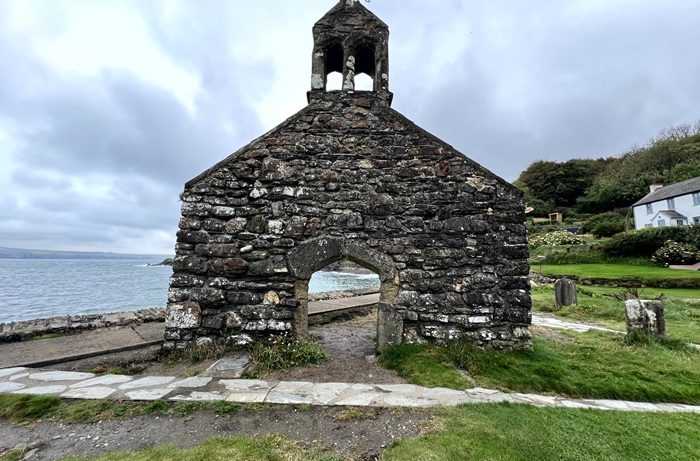
Cwm-yr-Eglwys meaning ‘Valley of the Church’ is a hamlet in a stunning cove on the eastern side of the Dinas Island Peninsula, so called because a stream separates it from the mainland. It features a sandy cove, with a stream running through the centre, providing tens of rock pools teeming with life. On the eastern side of the bay is a secluded cove which can only be accessed by walking over the rocks at low tide or a short swim. Overall, an exciting place to enjoy a beach-day but what is not commonly known is that Cwm-yr-Eglwys has connections to the earliest history of Christianity in Wales.
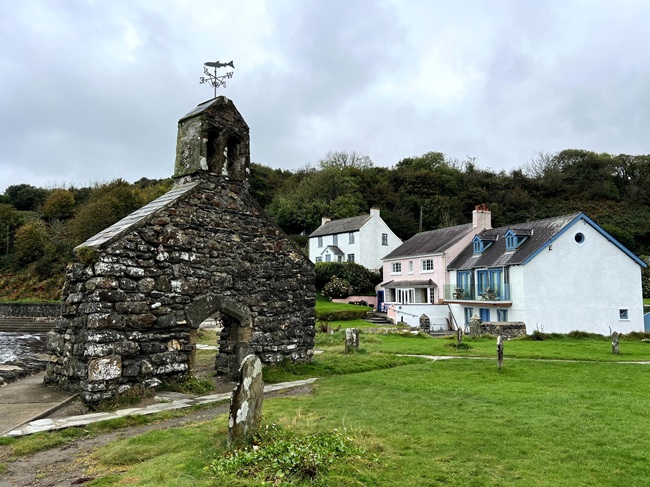
The highlight of the hamlet is without a doubt the ruins of the Church of St. Brynach the Abbot. The church sits on the site of an ancient llan dating back to the early days of Welsh Christianity, and the dedication is pre-Norman. The structure which can be seen today dates from the 12th century and conforms to the style expected of architecture of the period. It once had a nave, and a chancel connected in a rectangular building with plain frontage and a bell housing.
The church however was damaged several times. The building suffered storm damage in both 1850 and 1851 when the chancel was destroyed by the raging sea. The church footings were left hanging over an abyss. The worst effect of the damage was the harm done to the graveyard. Much of the earth was washed away at depths of up to three feet which exposed many human remains. Then came the Royal Charter Storm, also known as the Great Storm of 1859, which battered Wales on 25th and 26th October that year. Meteorologists considered this to be the most severe storm to hit the Irish Sea in the nineteenth century, with a death toll of over 800. The storm took its name from the Royal Charter ship which was run aground by the force of the weather upon the east coast of Anglesey, Wales at the cost of 450 sailors.
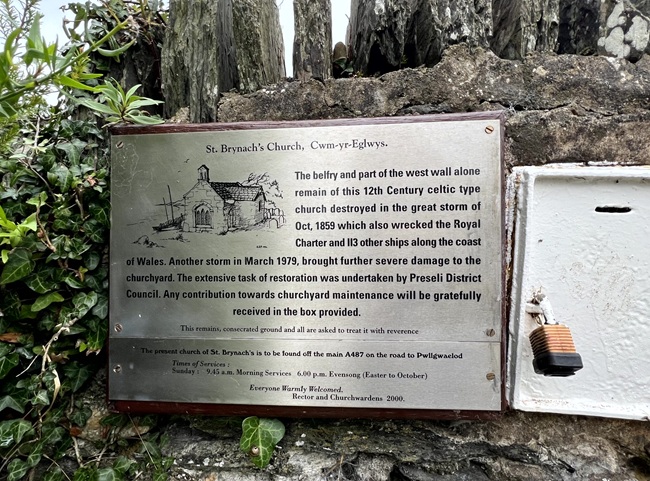
At Cwm-yr-Eglwys the storm ripped the roof from the church and weakened the walls. The building was now teetering on the edge over the beach and completely unsafe. Therefore, it was immediately abandoned. In 1880, what was left of the Church of St. Brynach the Abbot was demolished except the west entrance wall. In addition, a new sea wall was constructed to protect what remained of the accompanying graveyard.
A new church was constructed in 1860-1 to replace the old medieval Church at Cwm-yr-Eglwys but this one was situated in the relative safety of the road into neighbouring Bryn-henllan. The newchurch, designed by R.K. Penson, is constructed of brown rubble stone and Welsh slate roofs. The building is made up of a low nave, a narrower chancel compared with the original, slated west bell turret, south-west porch, gabled vestry with chimney and both tracery and lancet windows. The porch contains a deconstructed thirteenth century font taken from another medieval foundation. It now serves as the parish church for Cwm-yr-Eglwys and bore the same name, St. Brynach’s.
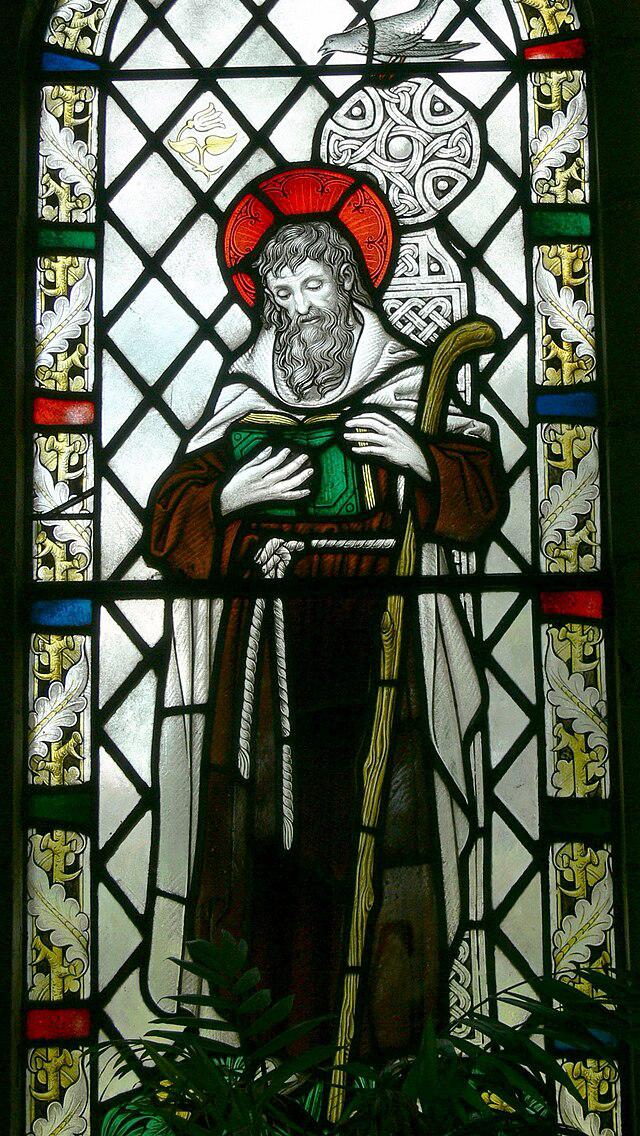
(Stained glass window depicting St Brynach in St. David’s, Wales. Taken by Wolfgang Sauber https://creativecommons.org/licenses/by-sa/3.0)
The man to whom both churches have been dedicated is the sixth century saint, Brynach. St. Brynach’s background is not totally clear. Much of what we know comes from a medieval hagiography. These can be ever so useful for details of a person’s life, but it must be read carefully. Most hagiography is written in order to have someone canonised. The work can often be used as evidence for not only a saintly life but for the performance of miracles. Therefore, it can be tricky to know which stories are apocryphal.
St Brynach has sometimes said to have been the son of a King of Calabria in Italy, although this is unlikely. Instead, it is more probable that he was from Ireland since ‘Bernach’ is an Irish name and he is sometimes referred to as Brynach Wyddel: Brynach the Irishman. The Life of Brynach tells us that as a young man he made a pilgrimage to Rome and on his journey there defeated a serpentine beast. Upon his return from the Holy City, Brynach settled in Brittany where he spent some time preaching the Gospel to the native population. After this he came to Wales, the Life records that he floated across on a stone which if to be believed was probably his portable altar. Either way his reported landing spot was near modern day Milford Haven.
Brynach travelled to the north-east, Llanboidy in Carmarthenshire to be exact. Here he was denied a bed for the night by the locals and was forced to sleep in a cow-shed. Then at Colymaellwyd he was again shunned and had no choice but to rest beneath a large grey stone. Eventuallly, he decided to construct for himself a small hermitage at Llanfyrnach in Pembrokeshire. Brynach’s luck did not change however, he was badly injured by a spear wielding woman, whose advances had been rebuffed by the saint. Seemingly left for dead, a passer-by rescued him and washed his wounds in a nearby well. Making a full recovery the well became known as Fons Rubeus (The Red Well) and was said to grant healing.
St Brynach then tried to settle at Pont-faen on the River Gwaun but was driven from the land by demons. Then at Llwyn Henllan on the River Nevern he attempted to build his first church, but the locals stole all of his wood. Eventually, an angel appeared to him and told him that his previous failings were because these places were not meant for him. On hearing the angels words, Brynach moved yet again to the banks of the River Caman. Here he taught agriculture to the native Welsh and instructed them how to tie wild stags to their ploughs and how to milk the hinds. He also spent much time cutting down the trees for wood to finally build a church. The king in these lands, Clether, was very impressed by the actions of Brynach and his religious rhetoric so much so that he decided to abdicate his throne and become a Christian hermit at Kernow (Cornwall). His last act was to give Brynach all of his lands and to enlist his twenty sons to become the first monks at Brynach’s monastery that developed around his little church. As well as the monastery, Brynach founded churches at Dinas and Newport, near to the spot where the angel visited him on Carningli.
The most entertaining of the miraculous stories in the Life of Brynach is the tale of his cow. It is said that Brynach had a very large cow that could sustain all of the monks on its milk. It was even cared for by the saint’s tame wolf. However, one day King Maelgwn Gwynedd and his band of men travelled to Brynach’s monastery, demanding they be given sustenance and festivities. When St Brynach refused their requests, they slaughtered the cow and prepared its meat for cooking. By an apparent act of God the water would not boil and King Maelgwn believing it was a sign of the saint’s protection by the divine immediately apologised and offered to make amends. Brynach then performed another miracle by resurrecting the cow and producing a feast for those assssembled by plucking bread from the trees around the monastery. Astounded by these deeds, Maelgwn relieved Nevern Abbey of all taxation.
While based at Nevern, Brynach of travelled South Wales, founding churches as he went. These included Llanfrynach in Brycheiniog and llanfrynach and Penllin in Morgannwg. He also befriended Saint David, the patron saint of Wales, who often came to visit the abbey. During one particular visit St. David arrived with a beautifully decorated stone cross head. He had planned to take it to Llanddewi Brefi to commemorate the Synod he held there in 545 AD. However, St Brynach convinced his good friend to donate the cross head to him. Brynach then had an equally beautiful stone shaft produced and mounted the head on top. It was then placed in Nevern Abbey Church, a version of which still exists today but is said to be a 10th century reproduction.
St Brynach ended his life as a hermit in Devonshire but not before he spent time at the ancient llan of Cwm-yr-Eglwys. Here he evangelised the locals from his portable altar and was immortalised by them when the first stone church on the site was dedicated to him.
Written by C. James McPherson MA MSc.