
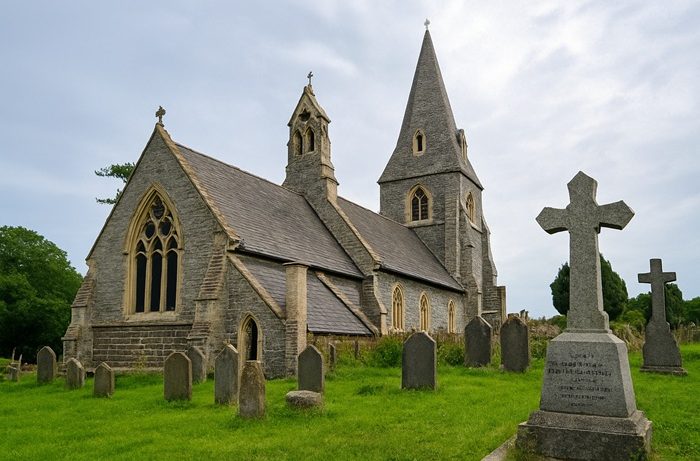
The coastal village of Llanrhystud is a very small community built-up in a historic landscape which features the old village, the bridge over the River Wyre and modern business and housing developments at the fringes of town. It lies roughly 20 metres above the sea in a location where the valleys open out into a coastal flatland. The oldest part of the village which remains at its core consists of a cluster of houses, cottages the Post Office, a public house, community hall, and a church close to Llanrhystud Bridge.
The Old Llanrhystud Bridge was built of stone with an arch spanning the River Wyre, this humpback bridge dated from c.1900 and was of the oldest buildings in the village. However, the bridge had to be modernised to carry new cars and public transport and was demolished. It was replaced by a nouveaux architecture single arch bridge spanning 38 feet.
The village church of Llanrhystud is dedicated to St. Rhystud, one time Bishop of Carleon-on-Usk and a missionary from Llydaw. Llydaw was often thought to be a location in Brittany where many of the holy men of the Age of Saints came from however more recent scholarship has suggested that this place might be closer to home, perhaps even in south-east Wales.
The present building dates from 1852, taking the place of a much earlier foundation, remnants of which can be seen in the West end of the church, under the belfry. This old door, with steps leading down to it, was only discovered during renovation work in 1958 when the plasterwork was being fixed. A workman noticed a number of holes to the right and left of the opening, these have been identified as the spaces which would have held the joists of a ‘rood loft’. The lower part of the Belfry is also medieval at its core and is said to have been laid in the fourteenth century if not before.
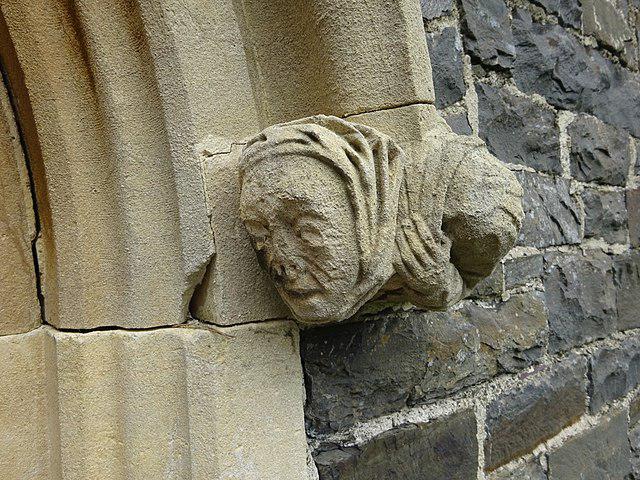
(Gargoyles of St Rhystud’s. taken by Llywelyn2000:
https://creativecommons.org/licenses/by-sa/4.0)
The first record we have of an incumbent at Llanrhystud parish is a ‘Griffith Powell’ who “on July 24th, 1582, was a witness before the Court Leet at Aberystwyth”. Here he had been “in 1544 appointed priest-in-charge-of Llanrhystud at the yearly stipend of five pounds”.
Many items of interest exist at St Rhystud’s none more so than the Cocoa-nut Cup. This object was used as a communion chalice until the beginning of the twentieth century and is dated about 1675. It takes its name from the bell, or drinking portion, of the cup being formed of a polished coconut in a silver mount. It is unique to the province of Cardigan, but there is another of its kind in the Diocese of St. David’s. Unfortunately, very little is known about its origins as no distinguishable assay marks can be seen on the silver. There is also the Bleeding Cup, a small pewter bowl which was uncovered in a local cottage, and donated back to the church where it is said it had been previously used as an alms basin. The front side bears the initials C.M. The baptismal font which is mounted on a newer stone pillar was removed from the original church and reused. It features an octagonal basin with lead lining. The Church Registers have been kept in good order and record as far back as 1700. Furthermore, the porch area has an ornate crown and mitre emblem while the exterior features many interesting gargoyles figures. Finally, the clock on the south wall of St. Rhystud’s is over one hundred years old and was a gift from the local sailors.
St. Rhystud’s was not the only medieval foundation in the village. A castle of Llanrhystud appears in the record around the 11th century and is often referred to as Dinerth Castle. In 1080 the castle belonged to an Iestyn ab Gwrgan, Prince of Glamorgan, and was then sacked by Rhys, Prince of south Wales. Having been rebuilt and refortified it was completely destroyed in 1135 by Owain Gwynedd and his brother, helped by Hywel ab Meredydd and Rhys Madog ab Enerth. Again, the castle was rebuilt, besieged and captured in 1150 with multiple other fortifications, this time by Cadell, Merdydd and Rhys, the sons of Grufydd ab Rhys, Prince of South Wales. These brothers were infuriated by the toughness of their opponents who had succeeded in killing some of the best warriors and made the decision to put the entire defeated garrison to the sword. When English control of the region tightened its grasp, Dinerth Castle was made a fortified place once more by Roger, Earl of Clare, in 1158. However, at the end of the 12th century the castle was besieged again and captured by Maelgwyn ab Rhys who also put this garrison to death. In 1204, to deny Llewelyn ab Iorwerth a fortress the castle was razed and this time not repaired. All that remains of Dinerth is the earthwork defences and the motte, a classic marker of these types of timber castle.
Other earthworks around the area reveal the presence of even earlier fortified places. Built on the surrounding hillsides of Llanrhystud, archaeologists have identified at least three medieval hillforts: Caer Penrhos, Castell Bach and Castell Mawr. Caer Penrhos was a perfectly sited, substantial ringwork castle, believed to have been built within the bounds of an earlier Iron Age hillfort which was used as a bailey. The timber castle is said to have been built in 1149 by Cadwaladr, son of Gruffydd ap Cynan. Although the wooden construction has long been lost to time the earth works and some of the best preserved in the region and really highlight the strength of the chosen location. Castell Bach appears as a small arc crowning the top of a grassy knoll. This feature is believed to have been a Bronze Age hillfort with remains of an ancient trackway running alongside. Finally, Castell Mawr, which lies about 200 yards to the south of Castell Bach, is an iron Age ringwork strategically placed on the edge of an escarpment which rises to some 300ft and overlooks the coastal plains of Llanrhystud. This site was originally a circular encampment enclosed by a single ringwork defence. However, this area is now agricultural farmland and due to cultivation, much of the evidence marks in the earth have been churned up. Furthermore, a small archaeological project undertaken at Castell Mawr sought to test a hypothesis that the site may have been an earlier henge, unfortunately despite an extensive search no such results were achieved.
In the age of industry, Llanrhystud had a number of working mills dating from around the 1840’s. Felin Ganol was a late eighteenth – early nineteenth century corn mill and house, built of local gritstone sits on the banks of the river. The local tithe maps show multiple alterations and expansions including an attached corn-drying kiln and a two-storey lime washed mill house dated 1872. When the mill first opened in 1841 it was owned by a David Saunders Davies and operated by his tenant, Richard Morgan. The mill itself is fed by a leat which fills the mill pond with water, the water then feeds an overshot waterwheel. The waterwheel construction is made up of a spur-wheel driving two pairs of mill stones and sack hoist. As the business grew a belt drive powered saw-bench was added and run by a prototype electrical generator which was powered by a turbine placed at the base of the waterwheel to harness its kinetic energy. Although the mill closed down as the industries declined in the twentieth century and grain became cheaper to import the twenty-first century saw a revival. In 2007 restoration of Felin Ganol was begun, the pond was then refilled in 2008 after having lay bone-dry for almost half a century and finally in the Spring of 2009 the original French Burr stones turned once again to produce wholemeal flour. Today, Felin Ganol continues to produce stoneground flours just as it did one hundred and fifty years ago.
One final building of interest in Llanrhystud is the Memorial Hall. The building was originally built in 1929 to commemorate those who served in the Great War. On its opening day a procession was held through the town and on entering the Hall the local clergy, ministers, ex-service men and relatives of the fallen gathered together at the marble mural tablet to the fallen heroes to pay their respects. The writer for the Welsh Gazette wrote of the day,
“Wednesday week was a notable day in the history of Llanrhystyd, for it was the occasion of the formal opening of the Memorial Hall. Standing on the Llanon side of the village, close to the main road, and on a plot of ground generously given by the Rev. Charles Williams, Ashford Rectory, Barnstaple, Devon – as an expression of gratitude for the return of his two sons unscathed from the Great War – the building is a convenient and well-designed one, rough casted with cement. The main hall is capable of accommodating 600 persons. The sides are match-boarded, and the roof is covered with russet brown tiles.”1
Written by C. James McPherson MA MSc.
Cover photo St. Rhystu Church – GBC – Sept 2024)