
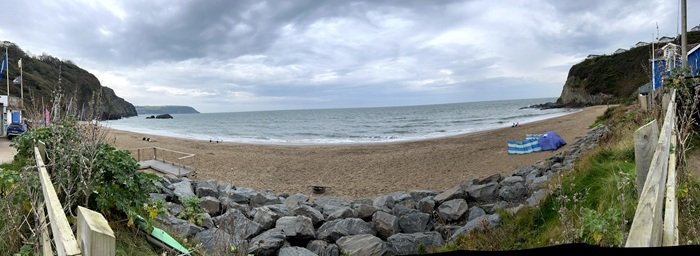
The gorgeous seaside village of Tresaith is a gem on the Ceredigion coast of Wales, with something to offer for everyone and only eight miles from the bustling markets of Cardigan. Tresaith boasts a blue flag beach, the wonderful Ceredigion Coastal Path which winds through the village and it hosts summer sailing events too! All this makes it a very popular tourist attraction or an exciting place for those looking for a tranquil place to buy property.
Before its surge of holidaymakers arrived in the nineteenth century, Tresaith was barely a village at all. It was home to the Ship Inn and a little thatched cottage, nothing more. Nevertheless, there are still a few interesting tales from the past to share about this seemingly minute area of sands. The Ship Inn was owned and operated by the Parry family. The Parry’s were also shipowners and their very first vessel New Hope, was constructed in 1827 on the beach at Tresaith. Later, in the second half of the nineteenth century Tresaith saw several small ships come and go on delivery runs to provide the village with various materials. These ships were usually smack vessels. A smack was a traditional fishing boat in use off the coasts of Britain and North America for much of the nineteenth century. It consisted of a heavy hull which had a well to keep the catch alive, in the case of the Tresaith smacks the well was ideal for shipping moderate quantities of solid cargo. These, normally 25-ton smacks, brought coal, limestone and culm to Tresaith for its local community.
The coal was the primary fuel in use as a heat source, the Ship Inn regularly welcomed in sailors who could warm themselves by the large open fireplace to dry out from the days fishing. Limestone was used in Tresaith for road and building construction, as holidaying by the beach became more popular additional lodgings were required to accommodate such an influx. Culm or cwlwm in Welsh is a fine anthracite dust found in coal deposits, particularly in Carmarthenshire and Pembrokeshire and was a common commodity around the coastal areas of Wales. It could be mixed with wet clay and formed into balls that when dried resulted in a slightly more cost-effective alternative to coal as a household fuel.
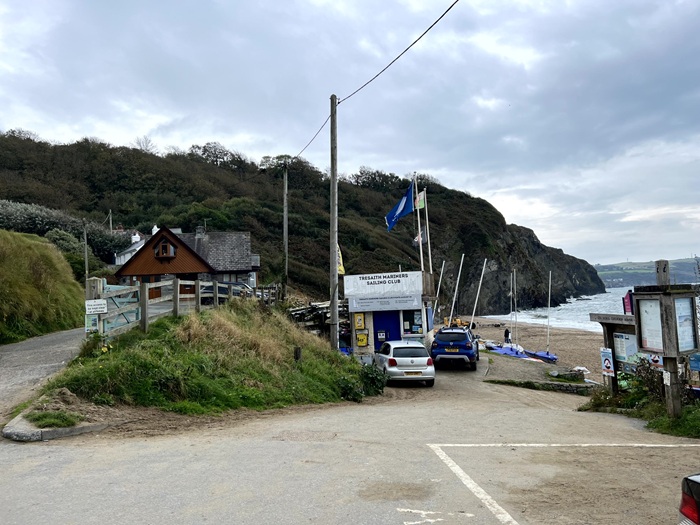
Down at the beach there is much natural history to observe. Firstly, are the spectacular creatures that can be sighted most summer days. These are Cardigan Bay’s resident bottle-nosed dolphin population. These incredibly intelligent mammals can live for up to forty years and even pass cultural knowledge from generation to generation, Moreover, their inquisitiveness means they often interact with humans. Many local fishermen have reported dolphins swimming alongside their boats, in some cases even in front of their boats as if they were guiding the men home. The other spectacular experience which can be enjoyed at Tresaith Beach is the waterfall. The River Saith winds its way down from the higher ground above Tresaith and through the village eventually cascading as a waterfall over the limestone cliffs onto the north of the beach. The cool spray that emanates from the rocks as the river splashes downwards have been said to be a wonderfully freshening experience after an enjoyable swim or perhaps after taking advantage of the excellent surfing conditions on the coastline.
The village is also famous in local children’s tales and Celtic folklore. Tresaith translates from the Welsh to ‘place of the seven’. Legend has it that an ancient Irish King who had seven daughters began to grow tiresome of their mischief. Although we do not know exactly what kinds of misbehaviour the girls were getting up to e are told that it was sever enough for the king to take drastic action. Fed up with their troublesomeness the king had his daughters loaded onto a boat and set adrift on the Irish Sea. After days of being jostled across the waves by the tumultuous and oft time unpredictable sea they ran aground on the Ceredigion coastline. The seven daughters were met from the boat by seven young and handsome farmers with whom it is said they instantly fell in love. Soon after they were wed and of course … live happily ever after. To commemorate their miraculous voyage and star crossed loves the point of their arrival became known as Tresaith or the place of seven.
Some years ago, Adam Buick a potter and film maker developed an innovative project based on the story of the seven Irish princesses sent out into the sea and who landed at Tresaith and married Welshmen. The project was titled: Crossings, Adam Buick and the legend of Tresaith with work by Valerie James, Margaret Pendrell and Meri Wells. The finished products were displayed at the Ceramics Gallery in Aberystwyth Arts Centre for several months during 2017. Reflecting on the theme of treacherous sea crossings, Buick designed and created seven moon jars that were deposited much like the daughters, into the Irish Sea with the hope that they would arrive unscathed in Ceredigion. With the assistance of the Computer Science Department of Aberystwyth University, in particular the students of the robotics workshop, Spot Gen3 tracking devices were implanted into each moon jar within its own acrylic chamber. These then tracked the movements of the jars as they traversed the sea.
The jars themselves were specially designed by Buick for sailing. Each jar was weighted at the bottom to prevent it from rolling over and the neck was purposefully high to be above the water and act as a sail. The tracking software recorded the journey of the jars which were shown to move north and south with each tide and blown eastward towards Wales by the winds which were the main factor in their movements. As such the map which the tracking software generated showed a zig-zagging pattern of travel in an overall easterly direction. The results were incredibly interesting and only serve to prove the unpredictability of the sea currents and the impact of weather conditions. Some pots landed on the Isle of Man, others in Cumbria and the rest never made it to shores.
Video Source: Adam Buick
Adam Buick made a short film about the project called Place of Seven that was exceptionally well received when played to a capacity audience at the Arts Centre Cinema during the International Ceramics Festival. The exhibition at the ceramics gallery also played the film accompanied by maps, surviving moon jars and works by Maragret Pendrell, Meri Wells and Val James who contributed their own interpretations of the theme of ‘crossings’.
Overall, Tresaith has a wonderful blend of nature, legend and industrial history that makes it a fine pitstop on a journey across the Ceredigion coast. The popularity with holidaymakers has continued past the nineteenth century boom and the village boasts excellent places to stay including the Ship Inn. In addition, there is also the historic Bryn Berwyn Country House. This hotel is a mere 10-minute walk from the beach and was originally built by a retired sea captain giving it a wonderful family feel with all the refinements of a luxury stay. Of course, the Ceredigion Coastal Path region has many stunning camping spots if one prefers to be more at one with nature. In any case do not pass up the chance to experience the village of Tresaith.
Written by C. James McPherson MA MSc.
Photos: GBC