
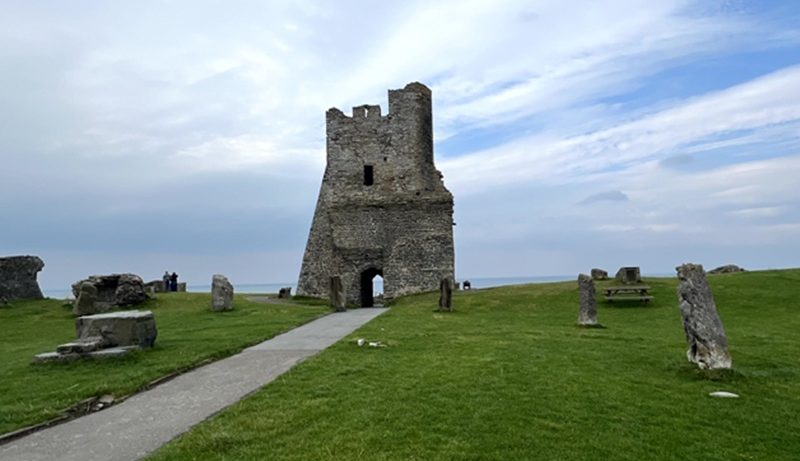
The poignant ruins of Aberystwyth Castle sit proudly on a promontory overlooking the harbour. These fragments are all that remains of a late 13th century castle constructed on the orders of Edward I of England in his efforts to conquer Wales. Throughout its history Aberystwyth was often at the centre of the conflict between the native Welsh and the invading forces from England, first under the Normans. Therefore, it is a truly interesting place that helps us to understand the tussle for control of all Wales that occupied much of the medieval period in Britain. Aberystwyth has many scars, some more visible than others, and a significant deep dive into the stories of the castle are the only way to truly understand its place in the making of medieval Britain. First, we will explore its origins in relation to the Norman Invasion of Wales 1067-1081, then the conquests of Edward I, followed by the rebellion of Owain Glyndwr and finally its role in the English Civil War. Overall, this piece will seek to paint a clear picture of Aberystwyth Castle’s connection to conflict.
The Arrival of the Normans
The Norman invasion of Wales began not long after the Norman conquest of England under William the Conqueror. Although England had been snatched with considerable fervour the ambition to absorb Wales was significantly less so. William I had believed the crown of the English to be his by right and by extension that thrones responsibility to neighbouring Wales and Scotland. Therefore, the Conqueror had little interest in claiming Welsh lands, however the native Welsh began to force the issue by supporting English rebellions against the Normans. To prevent further Welsh armies from coming to the aid of the native English King William created a series of earldoms near the border with Wales and endowed the associated titles on a number of his followers. Chester he gave to Hugh d’Avranches, Shrewsbury to Roger de Montgomery and Hereford to William FitzOsbern. These ambitious lords, not content with just defending their lands, began to take an interest in expansion into Wales. After a castle was established near the mouth of the River Wye, the Normans continued to move westward into Wales against the Welsh princes. These expansions continued into the reign of Henry I, including to Aberystwyth.
The original castle at Aberystwyth was built in 1110 by the Norman baron Gilbert Fitz Richard who had been granted the Lordship of Cardigan. It remained in Norman hands until 1136 when it was captured by the Welsh and held until 1143. The site of this castle consists of a large oval ringwork fortification on the back of a ridge, with a bailey 120ft long which runs along the ridge defended by a scarp up to 13ft high. The ringwork measures around 90ft by 70ft in total. Excavations have revealed that in 1143 when the Welsh lost the castle it suffered significant damage and that a new period of occupation began around 1200 when the ruins were levelled, and the entranceway was fortified.
Edward Longshanks and the Crushing of the Welsh
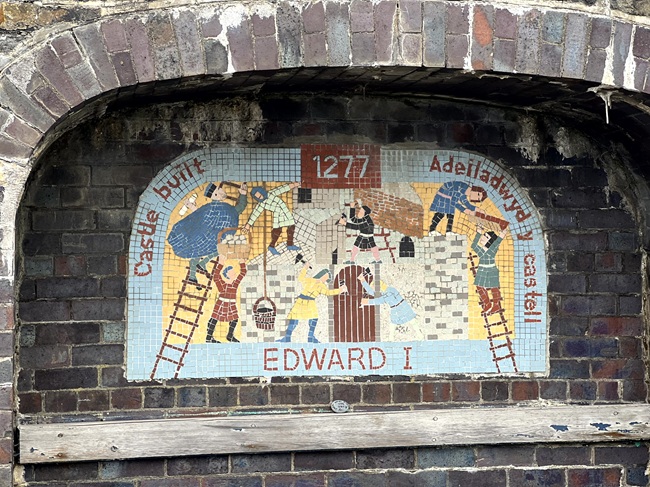
The conquest of Wales by Edward I was a series of campaigns that took place between 1277 and 1283 in two major phases. The first pinned Llywelyn ap Gruffudd back to his heartland of Gwynedd, during the second Edward completely overran him and took for himself the remaining Welsh principalities. The current structure we see at Aberystwyth was constructed in association with the first phase. Edward entrusted the oversight of building works at Aberystwyth to his younger brother Edmund, Earl of Lancaster. The stonemasons who came to Aberystwyth were mostly from Bristol and brought with them the freestone that was used for most of the doors and windows in the castle. The rest of the building was built using local hard gritstone. The castle was not yet completed when the rebellious Welsh attacked and captured it in 1282, destroying some of the completed work. During the second phase of the conquest Edward marched with a massive army into Wales that set about capturing Welsh strongholds via a three-pronged attack. William de Valence, Earl of Pembroke was responsible for warring south, and it was he who retook Aberystwyth Castle. The following year work resumed on the castle under the supervision of none other than the King’s own Master Mason James of St George. “Magistro Jacobo” was an architect from Savoy that found himself in the employ of Edward I from 1278 onwards, overseeing the construction of many of Edward’s grandest castles in England and Wales. James completed his work at Aberystwyth in 1289 at an estimated cost of £4300 which according to the Bank Of England would look something like £5.5m in today’s money. The success of Edward’s campaigns in Wales meant for a time Aberystwyth Castle sole purpose was administration of the King’s justice. When a small rebellion rose up in 1294 and besieged the castle the masterpiece of James of St. George easily withstood the Welsh.
The Rising of Owain Glyndwr
The year was 1400 and Owain Glyndwr, a Welsh knight and Lord of Glyndyfrdwy, had a bitter disagreement with a neighbouring English lord that spiralled into a national revolt that saw the common Welshman and some of their nobles warring against the occupying English army. Henry IV, in an effort to crush the spirit of the rebellious commonfolk, instigated a series of penal laws against the Welsh people that only drove them further to the side of Glyndwr. By 1404, Glyndwr and his supporters had besieged several castles and had won great victories in the field against forces of English soldiers, giving them almost full control of Welsh lands. As a result, Owain Glyndwr was ceremoniously proclaimed Prince of Wales in the presence of witnesses from France, Scotland and the Duchy of Brittany. He even called a parliament in Machynlleth with the intent of establishing two universities in Wales, reinstating their own ancient laws and creating an independent church in the Welsh rite. After two prolonged sieges Glyndwr managed to capture Aberystwyth Castle in 1406 and with Harlech Castle in the north utilised them in unison to form an administrative centre for his brief government of the region. Despite Owain’s good fortunes at the beginning, Henry IV soon mustered a significant army to reconquer Wales from him. The Welsh within Aberystwyth were overcome after a long siege in 1408, which saw one of the earliest uses of cannons in Britain. However, they were not as effective as future artillery would come to be, one even exploded killing its gun crew in the process. Instead, Aberystwyth was captured thanks to more traditional siege engines for the period.
Royalists vs. Parliamentarians
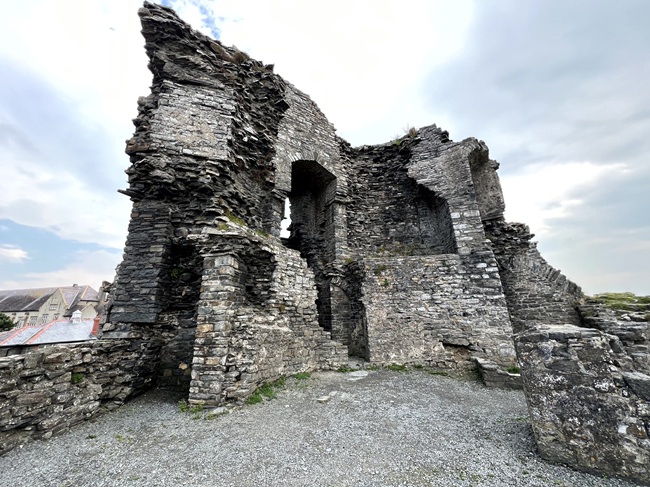
The Wars of the Three Kingdoms spilled over into Wales and many of its castles were garrisoned by supporters of one cause or another. Aberystwyth castle had been designated as a royal mint in 1637 by Charles I, minting silver coins from metal mined locally. This association was the reason for the Castle’s involvement in this war as the mint’s operator raised a regiment of Royalist soldiers and garrisoned them within Aberystwyth Castle in 1646. This was part of the First English civil War that was primary fought over the balance of power between Parliament and King Charles I. Royalists generally agreed that both the Houses of Parliament and the Church of England were subordinate to the king, while the Parliamentarians believed the king’s supremacy did not extend to religion and a form of constitutional monarchy was the way forward. These tensions boiled over into open conflict between the two sides and although initial feelings were that the war would be decided by a single battle these notions were soon dashed and a prolonged conflict ensued. In 1645, Parliament established the New Model Army, the first professional fighting force in England, who proved to be successful on the battlefield. It was these troops of the New Model Army under the command of Colonel Rice Powell who besieged Aberystwyth Castle and who managed after months of fighting to receive the surrender of the Royalist garrison. Shortly after the Castle was taken into Parliament’s hands Oliver Cromwell ordered its destruction to prevent it from being held against them in future, as such the castle was slighted an action which created the ruinous fortress visible today.
What Remains
The layout of Aberystwyth Castle can be clearly seen, it sits on a roughly diamond plan within concentric walls. There were double ring walls, corner towers and a pair of gatehouses. The outer ward is in a bad state of decay but the original gatehouse on the landward side still cuts an impressive shadow on the Aberystwyth horizon. Overall, despite its scars of war the castle still paints a clear picture of it past.
Written by C. James McPherson MA Msc.
Photos: GBC – Sept 2024